“My suffering is monumental; yours is personal.”
Warning: this is not exactly a review. It may contain swearing and material that may be triggering to some people. It may be more of a catharsis that had an affair with a review. Anyway. I went to see a play and at the time of writing this post I’ve just gotten back from it. In short, the play fucked me up in several monumental ways. The themes are rather relevant, I found, to the world’s current state of affairs. Don’t worry, I won’t get political.
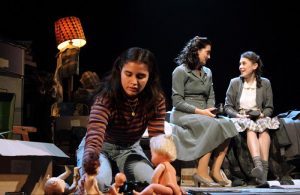
For those unaware (as I was of the fact that it had a specific name), The Kindertransport was a British rescue mission that took place at the beginning of WWII. Over 10,000 Jewish children from various countries were placed in British foster homes. One synopsis reads:
Helga and Werner Schlesinger are parents faced with the difficult choice of keeping their beloved daughter Eva in Germany with them, or letting her become one of the Kindertransport children, who are sent to the UK, alone. When Eva arrives in London, speaking no English, and feeling very much abandoned, she is taken under the wing of Lil Miller. The play jumps back and forth between three time periods: 1) Pre-war – in which Helga tries to prepare Eva to leave her home and parents; 2) War – in which Eva is living in England with Lil, adjusting to a new country, and desperately trying to get her parents out of Germany; and 3) Post-war, in which Eva (who has now changed her name to Evelyn) is an adult, has a daughter named Faith, and has intentionally wiped most of her past and her Jewishness out of existence.
Also, for those unaware, I was born in Eastern Europe and only moved to the UK to start uni.
Let me tell you, I cried my way through the second act of the play. I’m trying to put my thoughts in any sensible order.
We see Eva, who starts off uncertain about her future in England. As time goes by and after an initial period of adaptation, she becomes uncertain about her past. In one of the letters quoted, she makes comments about the bland taste of bread and tea… Towards the end of the play, she says she likes England and that’s where her home is. On a personal level, oh boy can I relate. I still haven’t learned to like the tea, but that’s beside the point. There are things here that I enjoy. I’ve started building my life and don’t think I could ever go back home, to the way my life used to be.
Spoiler alert, her mother survived the war. Years later, she goes to find Eva in England, only to see her grown up and calling herself Evelyn. I don’t introduce myself with my full name; instead I use a similar, Anglicised name. Evelyn, nee Eva, has perfect English, whereas her mother has a German accent. My mother also moved to England. I don’t sound Eastern European to most people, whereas my mum has a definite accent.
Despite the differences in reasoning, I did find the topic of amalgamation and erasure of identity… painful. For me, it was different, as I was building on top of who I already was. My mother, on the other hand, has had to bin two degrees to the point of removing them from her CV, because they would make her sound overqualified. In the play, Eva wants to bring her parents over and has to be told that they can’t be more than a cook and a butler, even though her father had been a bank manager in Germany before the war. Sound familiar? It still makes my blood boil that my mother had to scrape decades of her life because the subject matter (law, if anyone’s interested) doesn’t carry over. It makes me so angry that my home country has the fastest declining population in the EU because people just can’t survive there normally. It makes me angry that people who are trying to earn an honest living somewhere else are being demonised in the media. Anyway, I said I wouldn’t get too political.
In a conversation Eva has with her mother in her head, there is an accusation that the girl has lost herself while her mother only held on to life for the sake of her child. Setting aside the horrific context of that exchange and the circumstances that lead to it, I can’t help but feel a part of it. The parents of people my age deciding they’ll go abroad and work so they can support their children. People with established lives; people whose minds aren’t suited to learning a new language anymore; people who up and leave everything they’ve built because it just isn’t enough. Children are our gems, the play tells us. We survive through our children. I don’t have any of my own, but I can only imagine the pain of having to repeatedly tell your child to go make a life thousands of miles away because you know there’s nothing for them if they stay. Want is one thing; need is so much more painful.
I didn’t want to move away, exactly. As most teenagers, I didn’t really know what I wanted to do. But I kept being told that I need to, for my own good. You’ll be better off there, you’ll make a life there. Don’t get me wrong, travel is so easy nowadays, but it’s still completely different to be able to get the train to your mum if you feel pants one weekend, as opposed to getting to an airport, getting on a plane, getting home from the airport, etc, etc. You get the idea. That much distance will always take its toll on family ties and sense of identity.
Fast forward thirty or so years, Evelyn’s daughter is shocked to find out the truth about her mother. She wants to reconnect with that branch of the family whereas her mother wants nothing to do with her old life. I think I’ve slowly given up most of the traditions I used to observe. Granted, I never was particularly religious, but there are still small things that you don’t even realise make up your nationality. You are scattered into a million pieces and those pieces live in the way you choose your words, the small superstitions you have, the food you crave when you’re ill and tired, the holidays you consider important, not to mention the things you do on said holidays.
It is, of course, absolutely personal choice as to how much one decides to assimilate. I know people who want to only spend time with others from their country. I know people who all but live in fear of someone pointing out that they’re from whatever country. I consciously made a choice to soften my accent when I first came to England, since I sounded very American. There are things about my country that I really don’t like. There are things about it that I adore. I get homesick just like everyone else. I crave ‘home food’ sometimes. I mutter under my breath in a ‘foreign’ language at times. As I mentioned, I have no children, but I plan to one day. And to be perfectly honest with you, stranger on the internet, I have no idea how much I’ll insist on them learning about my background and traditions.
On a slightly more review-based note and following on from my post about conflict, I’d like to once again point out the significance of scale. It’s easy to feel indifferent to tragedy when large numbers and large scale are thrown in your face. It is much more difficult to remain indifferent when you are shown the story of an individual affected by the tragedy. I wouldn’t have spent nearly an hour of my life crying if the play wasn’t so personal.
And for anyone who would like to be completely fucked up by the individual tragedy during war-time, I would recommend Deathless by Catherynne M. Valente. It has elements of fantasy and folklore interwoven with times of political instability and war in Russia. Go have a read. I think that caused me a good five hours of crying.